Sources: Welsh Government, Attendance and absence from secondary schools 2024/25; Wellbeing of Wales 2025; National Survey for Wales 2024–25.
Behind every number is a life.
Find the barrier, understand what's causing it and together we can build solutions that actually work.
Removing barriers to participation
Julie left school at 15 with no qualifications and has never followed a particularly conventional route. She knows what it feels like not to fit neatly into the boxes that society creates for us, and much of her working life has been spent questioning whether those boxes need to be there in the first place.
From North Wales, she went on to build successful businesses, work nationally and internationally, and mentor others to turn their own ideas into something real and sustainable.
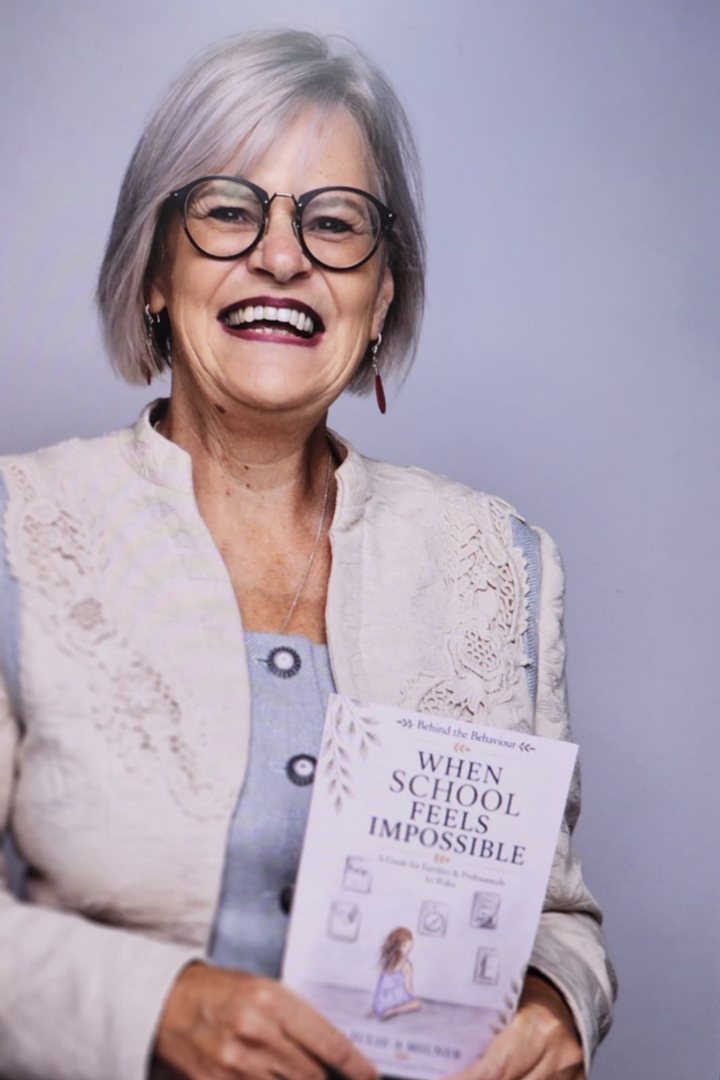
The books are another way Julie turns experience into action. When School Feels Impossible began with a striking realisation: Julie left school at 15, her own child later struggled with school, and more than 40 years later families are still facing many of the same barriers.
Julie can't support every family herself. But one book, one practical tool or one change in understanding can reach thousands.
The settings may change, but Julie's approach is consistent: look at the whole picture – psychological, biological, environmental and behavioural – to understand what is really getting in the way, before trying to find the individual solution.
Julie talks about what sits behind the behaviour – the barriers we don't always see, why people struggle to take part and practical ways to make things work differently. 88 videos and counting.
 ▶17:07
 ▶13:46
 ▶16:21
For journalists, podcast hosts, event organisers and partners. Download Julie's bio, photos, book information and media resources.
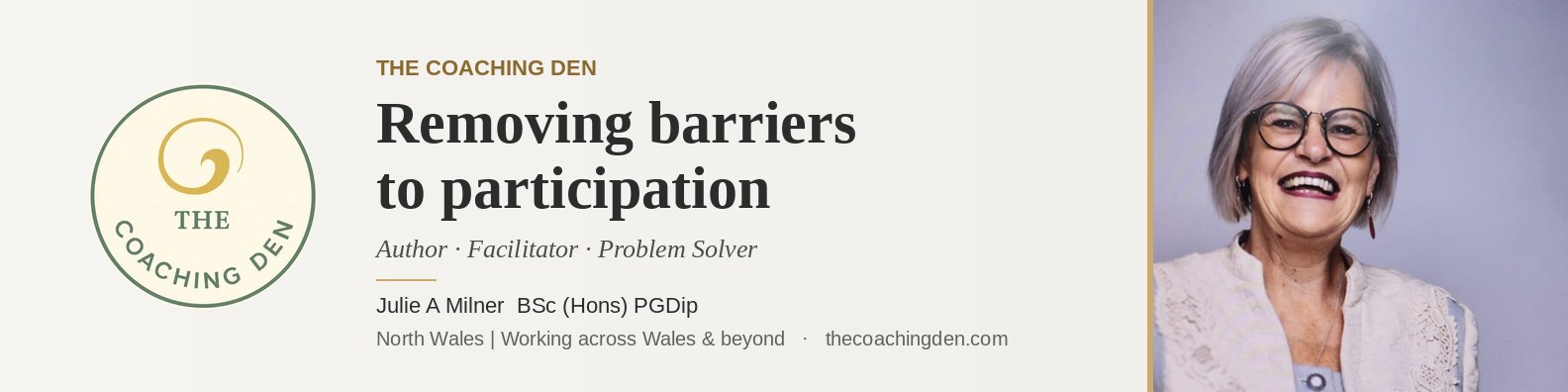
Julie A Milner is a North Wales-based author, facilitator and problem solver. Through her Behind the Behaviour Four Pillars approach – psychological, biological, environmental and behavioural – she looks beyond what we see to understand what is getting in the way of participation and find practical ways forward.
Julie A Milner is a North Wales-based author, facilitator and problem solver whose work focuses on removing barriers to participation. Having left school at 15 with no qualifications, Julie has never followed a conventional route. She went on to build successful businesses, work nationally and internationally, and support others to turn their own ideas into something real and sustainable.
Her Behind the Behaviour Four Pillars approach looks at the whole picture – psychological, biological, environmental and behavioural – to understand what is really getting in the way before trying to fix it.
Her first book, When School Feels Impossible, grew from both personal and family experience of struggling with education. It begins a wider Behind the Behaviour series, turning lived experience into practical help that can reach many more people than Julie could support individually. Her next book, When Work Feels Impossible, explores what happens when traditional ways of working simply don't work for everyone.
Approved for use in press, event programmes and partner materials. Please credit as Julie A Milner.
If the download doesn't start, right-click the image (or press and hold on a phone) and choose Save image.
A few lines is plenty. I'll reply within two working days.